Module 3: Rancher Prime — Multi-Cluster Management
Module Overview
Rancher Prime is SUSE's enterprise-grade container management platform, built on the open-source Rancher project. It provides unified multi-cluster management, AI-powered operations, GPU multi-tenancy, and enterprise assurance — all backed by a single-vendor SLA from SUSE.
What Is Rancher Prime?
Rancher Prime is the commercial enterprise distribution of Rancher, designed for organisations that need production-grade Kubernetes management at scale. It wraps the open-source Rancher Kubernetes Management (RKE/RKE2) ecosystem with enterprise SLAs, hardened security profiles, extended lifecycle support, and premium SUSE-backed tooling.
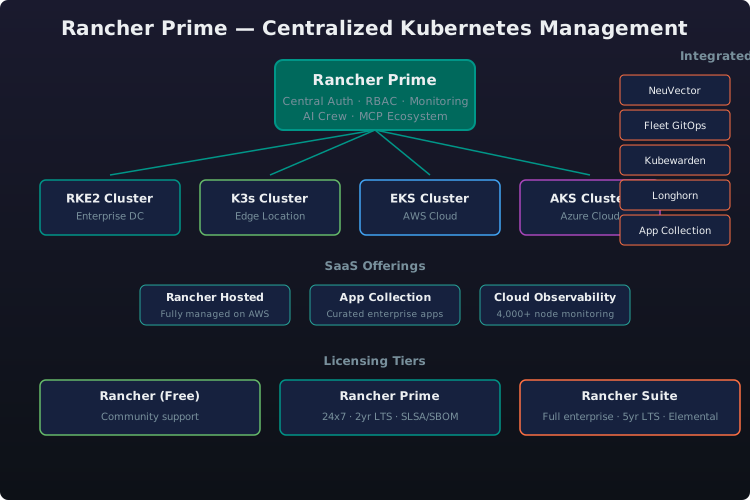
"Rancher Prime is not 'another Kubernetes distro' — it is the control plane for all your Kubernetes clusters, whether they run RKE2, K3s, AKS, EKS, GKE, OpenShift, or vanilla upstream K8s."
Architecture Overview
Core Capabilities
Multi-Cluster Management
Rancher Prime provides a single pane of glass for managing hundreds or thousands of Kubernetes clusters across on-premises, cloud, and edge environments:
- Cluster lifecycle management — Create, import, upgrade, and delete clusters through a unified API and UI
- Fleet-based GitOps — Deploy workloads across fleets of clusters declaratively (see Module 7: Storage & GitOps)
- RBAC federation — Map organisational roles (Team A, Team B) to Kubernetes namespaces across clusters
- Centralised observability — Prometheus + Grafana + logging dashboards aggregated across all clusters
- Multi-tenancy — Virtual clusters and project-scoped permissions
AI-Powered Operations (Crew & MCP)
Rancher Prime introduces AI-assisted cluster operations:
| Capability | Description |
|---|---|
| Rancher Crew | AI-driven cluster troubleshooting assistant that diagnoses issues, suggests fixes, and can execute remediation actions via natural language |
| MCP (Model Context Protocol) | Standardised protocol for LLM-to-Kubernetes interaction — allows AI models to read cluster state and perform authorised actions through a controlled interface |
| Intelligent drift detection | AI-powered comparison of actual vs. desired cluster state with automated remediation proposals |
GPU Multi-Tenancy
Rancher Prime supports GPU workload isolation through:
- NVIDIA GPU Operator integration — Automated GPU driver installation and monitoring
- Time-slicing & MIG — Partition GPU resources across multiple tenants
- GPU quota enforcement — Per-namespace and per-project GPU limits
- Observability — GPU utilisation metrics in the central dashboard
Cluster Lifecycle
| Feature | Description |
|---|---|
| Cluster Creation | One-click deploy of RKE2, K3s, AKS, EKS, GKE, and custom clusters |
| Cluster Import | Import any existing K8s cluster (including non-SUSE distros) |
| Upgrade Orchestration | Rolling upgrades with health checks, rollback support, and maintenance windows |
| Backup & Restore | Integrated etcd backup/restore with S3-compatible storage targets |
| Certificate Management | Automated certificate rotation and renewal |
Observability
- Built-in monitoring — Prometheus Operator deployed on each cluster with central aggregation
- Logging — Fluentd/Bottlerocket-based logging pipeline with Elasticsearch or Loki backends
- Alerting — Centralised alert routing to PagerDuty, Slack, email, Webhook
- Cost visibility — Multi-cloud cost allocation dashboards (Prime tier)
Enterprise Assurance
- 99.9% SLA on the Rancher Prime management plane
- Long-term support (LTS) releases with 2-year maintenance commitment
- FIPS 140-2 validated cryptographic modules
- SOC 2 Type II certified SaaS offerings
- Vulnerability disclosure program with SLA-backed patch timelines
- Single-vendor support — one phone call for the entire stack
Licensing Tiers Comparison
| Feature | Free / Community | Prime | Suite |
|---|---|---|---|
| Cluster management | Up to 5 clusters (Free Rancher) | Unlimited | Unlimited |
| Rancher UI & API |  |
|
|
| Multi-cluster RBAC | |
|
|
| Cluster import (any K8s) | |
|
|
| RKE2 / K3s provisioning | |
|
|
| GitOps with Fleet | |
|
|
| Monitoring & logging | Basic (single-cluster) | Centralised multi-cluster | Centralised multi-cluster |
| Enterprise SLA (99.9%) |  |
|
|
| LTS releases (2 year) | |
|
|
| FIPS 140-2 | |
|
|
| SOC 2 compliance | |
|
|
| Vulnerability SLA | |
|
|
| Rancher Crew (AI) | |
|
|
| GPU multi-tenancy | |
|
|
| NeuVector container security | |
Add-on | |
| Harvester VM management | |
Add-on | |
| Kubewarden policy engine | |
Add-on | |
| Harvester VM management | |
Add-on | |
| SUSE Manager integration | |
|
|
| Premium support (24/7) | Community support only | Business hours | 24/7 with 1-hour SLA |
| Pricing model | Free (no license) | Per-cluster subscription | Per-cluster suite bundle |
SaaS Offerings
Rancher Prime is also available as managed SaaS, reducing operational overhead:
Rancher Hosted
A fully managed Rancher Prime control plane running on SUSE's infrastructure:
- No need to install, maintain, or upgrade the Rancher management server
- Connect your existing clusters (on-prem or cloud) via agent
- Automatic upgrades to latest Prime release
- Included in Prime licensing tier
App Collection on AWS
Pre-hardened, Rancher-managed application stack available on AWS Marketplace:
- One-click deploy of Rancher Prime + NeuVector + Kubewarden + Longhorn
- Integrated billing through AWS
- Pre-configured security policies and compliance baselines
Cloud Observability on AWS
Managed observability backplane for Rancher-managed clusters:
- Centralised metrics, logs, and traces stored in SUSE-managed S3
- Pre-built dashboards for Kubernetes health, cost, and security
- 90-day retention included; extendable
Rancher Prime vs Rancher (Community)
| Dimension | Rancher (Community) | Rancher Prime |
|---|---|---|
| Licence | Apache 2.0 | Commercial (subscription) |
| Support | Community (GitHub Issues, forums) | SUSE Enterprise Support with SLA |
| Release cadence | Rolling, no LTS | LTS releases with 2-year support |
| Security patching | Best-effort | SLA-backed with CVE timelines |
| Certified integrations | Community-tested | SUSE-tested and validated |
| FIPS / SOC 2 | Not available | Included |
| AI operations (Crew) | Not available | Included |
| Cluster limit | 5 clusters in UI (no limit via API) | Unlimited |
| Upgrade assistance | Manual | Automated with rollback |
When to choose Prime over Community
If you run Kubernetes in production — especially across multiple clusters, in regulated industries, or with compliance requirements — Rancher Prime's SLA, LTS, FIPS, and support are worth the subscription. The Community edition is excellent for dev/test, labs, and smaller deployments.
The "Why Rancher Prime" Positioning Script
"Your customers are running Kubernetes on AWS, on-prem with RKE2, and at the edge with K3s — each with different security policies, different upgrade cycles, and different teams. They need one control plane that can federate all of them, while meeting enterprise compliance.
Rancher Prime is that control plane.
It's the only platform that gives you multi-cluster management, AI-powered operations via Crew and MCP, GPU multi-tenancy for ML workloads, and enterprise assurance with SLA, FIPS, and SOC 2 — all backed by SUSE as a single vendor.
No stitching together open-source components. No explaining to auditors why you're using community builds. Just one subscription, one support line, one platform."
Integration Points
Rancher Prime is the hub of the SUSE Cloud Native ecosystem. Key integrations include:
NeuVector — Container Security
Rancher Prime integrates deeply with NeuVector for runtime security:
- Single-click NeuVector deployment on any managed or imported cluster
- Security events appear in the Rancher Prime dashboard
- NeuVector admission controls integrate with Rancher's policy engine
- Vulnerability scan results visible per-namespace and per-project
Kubewarden — Policy as Code
Kubewarden policies can be applied at the cluster level through Rancher Prime:
- Manage Kubewarden policies from the Rancher UI
- Enforce admission policies across fleets via Fleet
- Audit mode for dry-run policy evaluation
Fleet — GitOps
Fleet is the built-in GitOps engine in Rancher Prime:
- Deploy workloads to hundreds of clusters from a single Git repository
- Support for Helm, Kustomize, and raw YAML
- Drift detection and automatic reconciliation
Longhorn — Persistent Storage
Longhorn delivers enterprise-grade block storage:
- Deployed through Rancher Prime's app catalog
- Integrated backup to S3-compatible targets
- Volume snapshot and restore from the Rancher UI
Harvester — Virtualization
Harvester VMs appear alongside containers in the Rancher Prime dashboard:
- Unified VM + container management
- VM-to-Pod networking across Harvester and RKE2 clusters
- Harvester images managed through Rancher's container registry
Summary
| Topic | Key Takeaway |
|---|---|
| What it is | Enterprise Kubernetes management platform |
| Killer feature | One control plane for any K8s cluster, anywhere |
| AI differentiator | Rancher Crew + MCP for AI-driven operations |
| Security | FIPS 140-2, SOC 2, SLA-backed patching |
| Licensing | Free (5-cluster limit) → Prime (unlimited) → Suite (bundle) |
| SaaS options | Rancher Hosted, App Collection on AWS, Cloud Observability on AWS |
| Key integrations | NeuVector, Kubewarden, Fleet, Longhorn, Harvester |
Further Reading
- Module 2: Kubernetes Distributions (RKE2, K3s) — The clusters Rancher Prime manages
- Module 4: Security with NeuVector — Deep dive on container security
- Module 5: Virtualization with Harvester — VM management alongside containers
- Module 7: Storage & GitOps — Longhorn and Fleet deep dive
- Module 8: Policy as Code with Kubewarden — Admission policies for Rancher clusters
- Module 11: MultiLinux Management — Managing heterogenous Linux environments alongside Kubernetes