Quick Reference Card
A pocket-ready reference for the SUSE portfolio. Use this card during study sessions and as a quick-reference during customer conversations.
Product → Customer Need Matrix
Use this table to map a customer pain point directly to a SUSE product. In conversations, starting with the need — not the product — earns credibility.
| Customer Need / Pain Point | Primary SUSE Solution | Supporting Components | Module |
|---|---|---|---|
| "We need a secure, compliant K8s for production" | RKE2 (CIS-hardened, FIPS, SLE BCI) | Rancher Prime, NeuVector, OCI Prime Registry | 2 |
| "Our clusters at the edge need a lightweight K8s" | K3s (<100 MB, ARM64, offline) | Elemental, SUSE Edge, Fleeet | 2, 6 |
| "Managing 50+ clusters across clouds is chaos" | Rancher Prime (multi-cluster mgmt) | Fleet (GitOps), OCI Prime Registry, Cluster API | 3 |
| "Container security keeps our compliance team up at night" | NeuVector (zero-trust, DLP, WAF, runtime) | Kubewarden (policy), OCI registry scanning | 4 |
| "vSphere licensing costs are out of control at the edge" | Harvester (VM on K8s, KubeVirt + Longhorn) | Elemental, Rancher Prime (management) | 5 |
| "We need consistent K8s from factory floor to data center" | SUSE Edge (3 variants: Edge/Industrial/Telco) | Elemental, K3s, Rancher Prime, Longhorn | 6 |
| "Our stateful apps need reliable persistent storage on K8s" | Longhorn (distributed block storage) | Rancher Prime Backup, Velero | 7 |
| "GitOps across 100 clusters without a management nightmare" | Fleet (multi-cluster GitOps engine) | Rancher Prime, Git repos, OCI artifacts | 7 |
| "We need context-aware, lightweight policy enforcement" | Kubewarden (WebAssembly policies) | NeuVector (runtime), Policy Hub (250+ policies) | 8 |
| "Our Linux fleet is a mix of SUSE, RHEL, and Ubuntu — management is fragmented" | SUSE Multi-Linux Manager (patch mgmt, compliance, automation) | Salt automation, CIS benchmarks, RBAC | 9 |
| "We want to cut RHEL support costs without losing enterprise support" | SUSE Multi-Linux Support (single support for any Linux) | Unified SLA, L3 engineering, migration tools | 9 |
| "Our SAP workloads need a certified, stable platform" | SUSE Linux Enterprise + Rancher Prime | SAP-certified K8s, Temenos Core validated | 9 |
| "We need AI/ML infrastructure without vendor lock-in" | SUSE AI + Rancher Prime | GPU scheduling, Kubewarden for AI governance | 9 |
| "OCI supply chain security and compliance" | OCI Prime Registry (SLSA L3, SBOM) | Rancher Prime, NeuVector (scanning) | 3 |
| "VM sprawl at remote sites with no local IT" | Harvester + Elemental (VM + OS lifecycle) | Rancher Prime (central mgmt), Longhorn (storage) | 5, 6 |
Competitive Comparison Matrix
The 'Why SUSE?' Answer
Every SUSE product competes against an incumbent. The table below shows how SUSE stacks up against Red Hat (OpenShift), VMware (Tanzu/vSphere), and DIY (vanilla K8s + community tools) across the dimensions that matter most to enterprise buyers.
| Dimension | SUSE / Rancher Prime | Red Hat OpenShift | :material-vmware: VMware Tanzu / vSphere | DIY (Vanilla K8s) |
|---|---|---|---|---|
| Licensing | Per-core subscription, portable, no cluster limits | Per-core, expensive RAM-based pricing | Per-core or per-VM, vSphere tax | Free + operational cost |
| Open Source | 100% upstream — RKE2/K3s/NeuVector/Harvester/Longhorn/Kubewarden all open source | Downstream OKD, but RHEL CoreOS is proprietary | Minimal — mostly proprietary | 100% open source |
| K8s Distribution | RKE2 (hardened, FIPS) + K3s (lightweight) — choice | OpenShift (only one K8s) | Tanzu (TKG — wraps upstream) | Whatever you choose (kubeadm, KIND, etc.) |
| Security | NeuVector (zero-trust, DLP, WAF, runtime) — only K8s-native full-stack | Advanced Cluster Security (spun-off, extra cost) | NSX-based (network-centric, not container-native) | Up to you — manual integration |
| Edge | K3s <100 MB + Elemental + 3 SUSE Edge variants | MicroShift (limited), OpenShift on RHEL for Edge | VMware Edge (heavy, requires vSphere) | Whatever you build |
| VM Capabilities | Harvester — native VM on K8s (KubeVirt + Longhorn) | OpenShift Virtualization (KubeVirt-based) | vSphere (mature but separate) — Tanzu VMs are add-on | Roll your own KubeVirt |
| GitOps | Fleet (native, multi-cluster, built into Rancher) | Argo CD (add-on, not native) | Add-on only | Argo CD / Flux |
| Policy | Kubewarden (WebAssembly, context-aware) — native | Gatekeeper (OPA) add-on | OPAL/OPA — add-on | Gatekeeper / Kyverno |
| Storage | Longhorn (distributed, open source, K8s-native) | OpenShift Data Foundation (Ceph, complex) | vSAN (proprietary, expensive) | Rook/Ceph, OpenEBS |
| SAP Validation | Certified — SLE + Rancher Prime | Supported, not primary | Not validated | Not validated |
| SLSA Level | L3 (OCI Prime Registry) | Undisclosed | N/A | N/A |
| Release Cadence | 4-month predictable cycles | ~6-month cycles | 12–18 month cycles | When you decide |
| Support Model | Single vendor — SUSE (enterprise SLA) | Red Hat | VMware | Multi-vendor or community |
| Management | Rancher Prime — cluster + apps + security + policies (single pane) | OpenShift Console + ACM (Acquires.io) | Tanzu Mission Control + Aria | Kubernetes Dashboard + custom tooling |
| TCO | 30–50% lower than VMware per IDC | Moderate | Highest ($12K+/core/yr) | Lowest (but highest ops burden) |
Key Competitive Narrative
SUSE's killer combination: The only vendor that delivers Rancher Prime (management) + K3s (lightweight) + NeuVector (security) + Kubewarden (policy) + Harvester (VM) as a single, integrated, open-source, enterprise-supported platform — without the lock-in of Red Hat or the cost of VMware.
Key Numbers to Remember
| Number | What It Means | Why It Matters in the Exercise |
|---|---|---|
| 15,000+ | Teams using Rancher | Credibility — "the most adopted enterprise K8s management platform" |
| $3.4M | Avg annual benefit (IDC) | ROI conversation starter |
| <100 MB | K3s binary size | Edge / IoT / resource-constrained environments |
| 1M+ | K3s active clusters | Community proof point |
| 5 years | Max LTS duration | Enterprise compliance, regulated industries |
| 4 months | Release cadence | Innovation pace + predictability |
| L3 | SLSA level (Rancher Prime Registry) | Supply-chain security differentiator |
| 250+ | Kubewarden policy catalog | Policy-as-code adoption velocity |
| 30,000+ | Longhorn deployments | Storage reliability proof |
| 5,000+ | Max clusters per Fleet controller | GitOps at scale |
| 3x | Harvester VM density vs. vSphere | Virtualization TCO argument |
| 3 | Edge deployment variants | Market coverage breadth |
| 20+ years | SAP on SUSE Linux | Enterprise trust, validated stacks |
| 15,000+ | NeuVector CVEs detected (2024) | Security threat reality |
Product URLs & Reference Links
Core Products
| Product | Documentation | GitHub | Other |
|---|---|---|---|
| Rancher Prime | docs.rancher.com | github.com/rancher/rancher | suse.com/products/rancher |
| RKE2 | docs.rke2.io | github.com/rancher/rke2 | CIS benchmarks included |
| K3s | docs.k3s.io | github.com/k3s-io/k3s | k3s.io |
| NeuVector | docs.neuvector.com | github.com/neuvector/neuvector | neuvector.com |
| Harvester | docs.harvesterhci.io | github.com/harvester/harvester | harvesterhci.io |
| Longhorn | longhorn.io/docs | github.com/longhorn/longhorn | longhorn.io |
| Kubewarden | kubewarden.io | github.com/kubewarden | WebAssembly-based |
| Fleet | fleet.rancher.io | github.com/rancher/fleet | GitOps engine |
| Elemental | elemental.docs.rancher.com | github.com/rancher/elemental | OS lifecycle management |
| OCI Prime Registry | registry.rancher.com | — | SLSA L3, SBOM |
Strategic
| Product / Initiative | URL | Relevance |
|---|---|---|
| SUSE Edge | suse.com/products/suse-edge | Edge/Industrial/Telco variants |
| SUSE AI | suse.com/products/suse-ai | Enterprise AI on open infrastructure |
| SUSE Linux Enterprise 16 | suse.com/products/suse-linux-enterprise | Next-gen SLE (preview at SUSECON 2025) |
| SUSE Security | suse.com/security | Zero-trust + compliance |
| IDC Business Value Study | suse.com/rancher-idc | $3.4M avg benefit |
| SUSE MultiLinux Support | https://www.suse.com/products/multilinux-support | |
| SUSE Customer Portal | scc.suse.com |
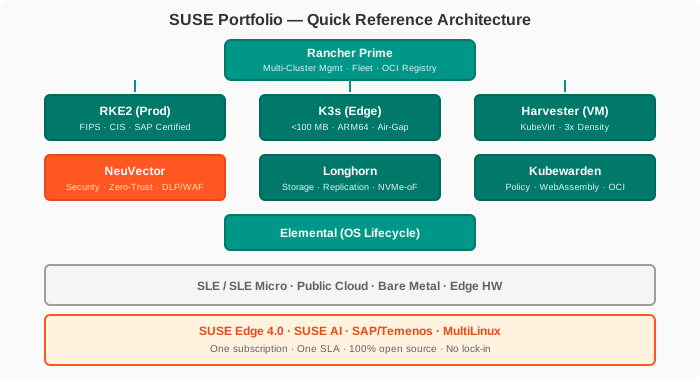
Quick Reference Architecture Diagram
Quick Quiz — Test Yourself
Self-Check Questions
Cover the answers with your hand and see if you can respond to each:
-
Q: A customer says "I need K8s for my factory floor with no internet." Which SUSE product?
A: K3s (offline-capable, <100 MB) + Elemental (OS management) — see Module 2 and Module 6. -
Q: "How is SUSE different from Red Hat OpenShift?"
A: SUSE gives you choice (RKE2 or K3s), native security (NeuVector, not spun-off), native GitOps (Fleet), native policy (Kubewarden), native VM (Harvester) — all open source. See Module 9. -
Q: "We're paying too much for VMware. What do you have?"
A: Harvester replaces vSphere at the edge with 3x VM density, Longhorn replaces vSAN, and Rancher Prime replaces vCenter. TCO 30-50% lower. See Module 5 and Module 9. -
Q: "Will you be around in 5 years?"
A: SUSE is 30+ years old, publicly traded, #1 on SAP Linux, with $3.4M avg customer benefit validated by IDC. See Module 1. -
Q: "What security do you have for containers?"
A: NeuVector — the only K8s-native platform covering zero-trust, DLP, WAF, runtime scanning, AI/ML model security. Add Kubewarden for policy-as-code. See Module 4 and Module 8.
Navigation
| Page | Description |
|---|---|
| Home | Landing page, study paths, key facts |
| Module 1: Strategy & Platform Overview | SUSE strategy, vision, portfolio architecture |
| Module 2: K8s Distributions | RKE2, K3s in depth |
| Module 3: Rancher Prime | Multi-cluster management, Fleet, OCI Registry |
| Module 4: NeuVector | Container security, zero-trust, DLP, WAF |
| Module 5: Harvester | VM platform on K8s |
| Module 6: Edge Computing | SUSE Edge 3 variants |
| Module 7: Storage & GitOps | Longhorn, Fleet, Backup |
| Module 8: Kubewarden | WebAssembly policy engine |
| Module 9: Ecosystem & Competitive | Competitive positioning, partnerships |
| Module 10: Sales Scenarios by Vertical | |
| Module 11: MultiLinux Management |
SUSE Portfolio Quick Reference Card — SUSECON 2025 Edition. June 2026.