Module 9: Ecosystem, Licensing & Competitive Positioning
Module Purpose
Build deep competitive fluency across the SUSE cloud native landscape — understand exactly how SUSE stacks up against Red Hat OpenShift, VMware Tanzu/vSphere, managed cloud Kubernetes services, and DIY/upstream approaches. Master the VMware post-Broadcom migration narrative and the CNCF project contribution story.
The Competitive Landscape — At a Glance
SUSE competes in a market where every major infrastructure vendor has a Kubernetes story. The table below shows where each competitor sits:
| Competitor Category | Primary Products | SUSE's Advantage |
|---|---|---|
| Red Hat (IBM) | OpenShift, ACS, OpenShift Virtualization | Multi-distro choice, no lock-in, native security (not spun-off), native GitOps (Fleet) |
| VMware (Broadcom) | vSphere + Tanzu, vDefend, vSAN | Post-Broadcom cost crisis, Harvester at 3x VM density, no per-core licensing shock |
| Cloud Providers (AWS EKS, Azure AKS, GCP GKE) | Managed K8s per cloud | Multi-cloud portability, on-prem + edge parity, single SLA across all environments |
| DIY / Upstream | Vanilla K8s (kubeadm, KIND, kops) | Enterprise SLAs, reference architectures, 5-year LTS, SLSA L3 supply chain |
The Opening Competitive Positioning Script
"Most infrastructure vendors will tell you they support Kubernetes. But here's the question: Do they give you a choice of distributions? Do they protect you from lock-in? Do they cover edge, data center, and cloud with a single SLA?
SUSE does. We're the only vendor that delivers Rancher Prime for management, RKE2 for production, K3s for edge, NeuVector for security, Harvester for VMs, Longhorn for storage, Kubewarden for policy, and Fleet for GitOps — all 100% open source, all under one subscription, with a single enterprise SLA.
We compete by giving you freedom — freedom to run any K8s distribution, any cloud, any hardware, without being locked into a proprietary ecosystem."
— SUSE Cloud Native Enablement Team
Full Portfolio Map
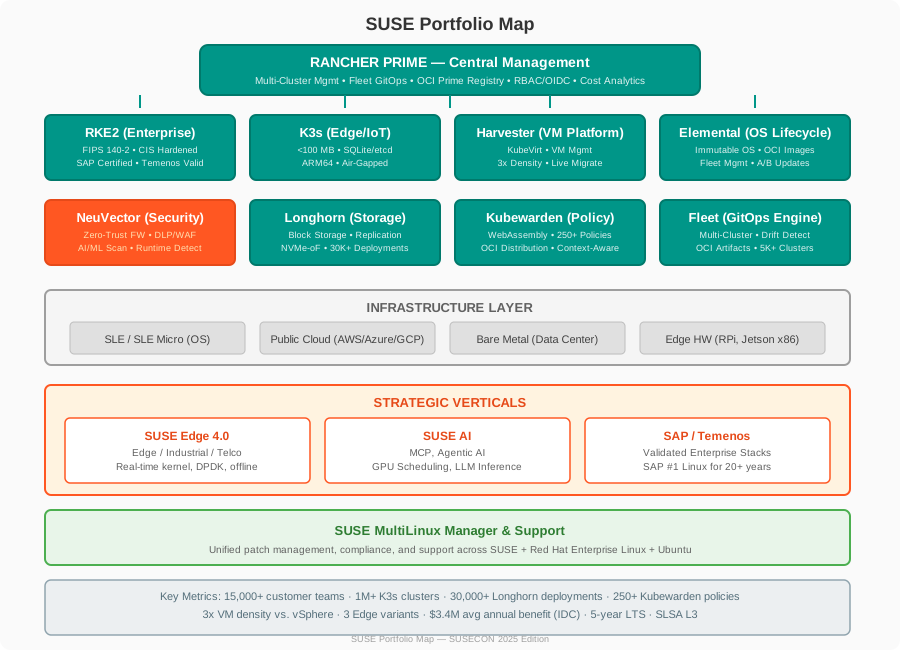
The 'Integrated Stack' Story
Every product in this map is engineered by SUSE (or its acquisition pipeline) and ships under a single subscription. No stitching together disparate open source projects. No multiple support contracts. One vendor, one SLA, one platform vision.
SUSE vs. Red Hat OpenShift — Detailed Comparison
OpenShift is SUSE's most frequent competitive comparison. While Red Hat has the broader enterprise Linux footprint, SUSE wins on architectural freedom, native security, and per-cluster cost transparency.
| Dimension | SUSE Rancher Prime | Red Hat OpenShift | SUSE Advantage |
|---|---|---|---|
| Distribution Flexibility | Two distributions: RKE2 (enterprise, FIPS, CIS) + K3s (<100 MB, edge) — choose per workload | One distribution: OpenShift (RHEL CoreOS only, ~1.5 GB+) — no lightweight option | ✅ Choice matters — K3s has no OpenShift equivalent at <100 MB |
| VM Management | Harvester — KubeVirt-native, 3x VM density vs. vSphere, live migration GA (Harvester 2.0) | OpenShift Virtualization — KubeVirt-based, but heavier footprint, fewer edge use-cases | ✅ Harvester is built for VM-first scenarios; OpenShift Virtualization is container-first with VM bolted on |
| Container Security | NeuVector (included) — K8s-native CNAPP: zero-trust firewall, DLP, WAF, runtime, AI/ML scanning, SBOM | Advanced Cluster Security (spun-off) — formerly StackRox, now separate subscription, extra cost | ✅ NeuVector is included in the subscription, not a separate SKU |
| Edge Computing | K3s (<100 MB) + Elemental + SUSE Edge 4.0 (3 variants) — offline, ARM, industrial | MicroShift (limited, still ~500 MB) + OpenShift on RHEL for Edge (heavy) | ✅ K3s has 100x smaller footprint than OpenShift |
| Licensing Model | Per-core subscription — no cluster limits, predictable, portable | Per-core RAM-based pricing — expensive for memory-dense workloads, cluster count matters | ✅ More transparent, no RAM tax |
| Open Source Commitment | 100% upstream — RKE2, K3s, NeuVector, Harvester, Longhorn, Kubewarden, Fleet all open source | Downstream OKD exists, but RHEL CoreOS, OpenShift Console, ACM are proprietary | ✅ You can run SUSE bits in dev for free; same bits in prod with SLA |
| GitOps | Fleet (native, built-in) — multi-cluster GitOps, drift detection, OCI artifacts, 5K+ clusters | Argo CD (add-on) — not native, must install and maintain separately | ✅ Fleet is built into Rancher Prime — no additional install |
| Policy as Code | Kubewarden (native) — WebAssembly-based, context-aware, 250+ policies, OCI distribution | Gatekeeper (OPA) — add-on, Rego language, not context-aware | ✅ Kubewarden's WebAssembly model is faster, safer, and more composable |
| Vendor Lock-In | Low — standard K8s APIs, any distribution, any cloud, OIDC auth | Moderate-High — OpenShift-specific APIs (Routes, DeploymentConfig), tight RHEL coupling | ✅ Migrate from SUSE to any K8s without rewriting |
| SAP Certification | Certified — SLE + Rancher Prime officially certified for SAP S/4HANA & BTP | Supported but not primary SAP validation | ✅ SUSE is #1 SAP Linux platform for 20+ years |
| Release Cadence | 4 months — predictable, enterprise-safe | ~6 months — slower cycle | ✅ Faster innovation, safer delivery |
| SLSA Level | L3 (OCI Prime Registry) — supply-chain artifacts | Undisclosed | ✅ Verifiable supply-chain security |
| TCO | 30–50% lower vs. VMware; competitive vs. OpenShift (no RAM tax) | Moderate — per-core RAM pricing adds up | ✅ Lower total cost for equivalent scale |
SUSE vs. OpenShift — The Positioning Script
"Customers often come to us comparison-shopping Red Hat OpenShift. Here's what they discover:
OpenShift gives you one K8s distribution — theirs. SUSE gives you a choice — RKE2 for hardened enterprise and K3s for lightweight edge, both managed from the same console.
OpenShift makes you pay extra for security (ACS is a separate SKU). SUSE includes NeuVector — the only K8s-native CNAPP — in the subscription.
OpenShift doesn't have native GitOps. SUSE has Fleet, built directly into Rancher Prime.
OpenShift doesn't have a lightweight edge distribution. K3s is the #1 lightweight K8s in the world — 1M+ clusters.
So the question isn't 'does SUSE compete with OpenShift?' — it's 'why would you pay more for less choice?' "
— SUSE Cloud Native Enablement Team
SUSE vs. VMware (vSphere + Tanzu) — The Post-Broadcom Shift
This is the most important competitive conversation in the market right now. Broadcom's acquisition of VMware has fundamentally changed the VMware value proposition — and created a massive migration opportunity for SUSE.
| Dimension | SUSE (Harvester + Rancher Prime) | :material-vmware: VMware vSphere + Tanzu | SUSE Advantage |
|---|---|---|---|
| Licensing Cost | Per-core subscription — predictable, portable, no surprise increases | Per-core + per-VM — Broadcom eliminated perpetual licenses, forcing 2-5x cost increases, bundling unwanted products | ✅ 40–70% TCO reduction reported by VMware migrants |
| Storage | Longhorn — open source distributed block storage, replication, NVMe-oF, SPDK v2 engine | vSAN — proprietary, expensive, complex capacity planning | ✅ Longhorn is included, not an add-on SKU |
| VM Migration | Harvester — KubeVirt-native, live migration GA (2.0), import tools from vSphere | vSphere — mature VM platform but proprietary, no easy path out | ✅ Direct VM migration tooling; same VM format via KubeVirt |
| Container Management | Rancher Prime — multi-cluster K8s mgmt, Fleet GitOps, NeuVector security, Kubewarden policy — all in one | Tanzu — multiple SKUs (Tanzu Mission Control, Tanzu Kubernetes Grid, Tanzu Service Mesh), confusing portfolio | ✅ Single platform, single SLA — not a collection of acquisitions |
| Hypervisor / VM Density | Harvester — 3x VM density vs. vSphere on equivalent hardware (independent benchmark) | vSphere — mature but lower density per host | ✅ 3x density = 3x cost savings on hardware |
| Edge / Remote Sites | K3s + Elemental + Harvester — lightweight, offline-capable, small footprint | VMware Edge — requires vSphere, heavy, expensive for small sites | ✅ Purpose-built for edge; VMware's edge story is vSphere in a smaller box |
| Ecosystem | 100% open source — CNCF projects, broad community, no proprietary APIs | Proprietary — VMware APIs, VMFS, vSAN, NSX — all locked in | ✅ Open = portable |
| Post-Broadcom Risk | Stable, independent — SUSE is publicly traded, 30+ years, no PE/VC overhang | Uncertain — Broadcom layoffs (VMware workforce cut ~40%), forced subscription conversion, product consolidation | ✅ Stability and predictability |
| SAP/Temenos | Certified — SAP-certified K8s, Temenos Core banking validated | Not validated for SAP on K8s or Temenos | ✅ Enterprise workload validation |
The VMware Migration Narrative (CRITICAL TALKING POINT)
Post-Broadcom VMware — The Market Reality
Broadcom's acquisition of VMware closed in November 2023. The impact on customers has been severe:
- 2–5x price increases on subscription renewals (per IDC and customer reports)
- Perpetual licenses eliminated — forced conversion to subscriptions
- Bundled products — customers must buy products they don't need
- ~40% workforce reduction — support quality has degraded
- End-of-life for VMware SaaS products (Aria, Tanzu SaaS)
- vSAN licensing changes — significant cost increases for storage
- Channel disruption — partner programs gutted, margin compression
This is the biggest enterprise infrastructure migration opportunity since the cloud shift.
SUSE VMware Migration — The Positioning Script
"If you're running VMware today, Broadcom has likely already told you about your next renewal price. Or asked you to buy products you don't need. Or both.
SUSE offers a clear path forward. Harvester replaces vSphere with KubeVirt-native virtualization — 3x VM density on the same hardware. Longhorn replaces vSAN — open source, no licensing games. Rancher Prime replaces vCenter — one console for VMs, containers, and edge.
And the best part? You don't have to forklift. Harvester imports your existing VMs. Rancher manages your remaining vSphere clusters alongside Harvester clusters. You migrate at your own pace — no rip-and-replace.
The TCO story is compelling: Customers migrating from VMware to SUSE report 40–70% lower infrastructure costs. Not 'maybe.' Not 'over time.' Real customers, real savings.
— SUSE Cloud Native Enablement Team
SUSE vs. Managed Cloud K8s (EKS / AKS / GKE)
Cloud providers make Kubernetes easy — inside their cloud. The moment you need to run workloads across clouds, on-premises, or at the edge, the managed K8s model breaks down.
| Dimension | SUSE Rancher Prime | AWS EKS | Azure AKS | GCP GKE |
|---|---|---|---|---|
| Multi-Cloud | ✅ Native — one Rancher console manages clusters on any cloud, on-prem, edge | ❌ AWS only | ❌ Azure only | ❌ GCP only |
| On-Premises | ✅ Full parity — same Rancher experience on bare metal, vSphere, air-gapped | ❌ EKS Anywhere (limited, extra cost) | ❌ AKS Arc (limited) | ❌ GKE on-prem (limited, Anthos-licensed) |
| Edge / Branch | ✅ K3s — <100 MB, offline, ARM, SQLite3 | ❌ No native edge K8s | ❌ No native edge K8s | ❌ No native edge K8s |
| Security (CNAPP) | ✅ NeuVector — included, full lifecycle | ❌ AWS Security Hub (add-on, per-feature cost) | ❌ Defender for Cloud (add-on) | ❌ Security Command Center (add-on) |
| VM + Containers | ✅ Harvester — native VM on K8s | ❌ No native VM support | ❌ No native VM support | ❌ No native VM support |
| Policy as Code | ✅ Kubewarden — native, WASM-based | ❌ OPA/Gatekeeper (manual setup) | ❌ Azure Policy for K8s (limited) | ❌ OPA/Gatekeeper (manual setup) |
| GitOps | ✅ Fleet — native, multi-cluster | ❌ Argo CD / Flux (self-managed) | ❌ Argo CD / Flux (self-managed) | ❌ Argo CD / Flux (self-managed) |
| Portability | ✅ 100% portable — standard K8s APIs, any infra | ❌ EKS-specific IAM, networking, CNI | ❌ AKS-specific identity, networking | ❌ GKE-specific networking, workload identity |
| Pricing Model | Per-core subscription — predictable | Per-cluster + per-resource — can scale unpredictably | Per-cluster + per-resource | Per-cluster + per-resource (zonal pricing) |
| SLA | Single SLA — full stack (OS, K8s, mgmt, security, storage) | Per-service SLA — no unified coverage | Per-service SLA | Per-service SLA |
| Offline / Air-Gap | ✅ Native — Fleet handles offline image sync, K3s single-binary air-gap install | ❌ Requires internet connection | ❌ Requires internet connection | ❌ Requires internet connection |
SUSE vs. Cloud K8s — The Positioning Script
"EKS, AKS, and GKE are great — if you never leave that cloud. But how many of your customers run workloads in one cloud? Or in a data center they already own? Or at a branch office with no cloud connectivity?
SUSE gives you one Kubernetes management experience across AWS, Azure, GCP, your data center, and your factory floor. Same Rancher console. Same Fleet GitOps. Same NeuVector security. Same Kubewarden policies. Same Longhorn storage.
No cloud provider can offer that. They're designed to keep you in their ecosystem. SUSE is designed to give you freedom.
And because we're 100% open source, the cluster you run in dev on your laptop is identical to what runs in production on any cloud. Try that with EKS. "
— SUSE Cloud Native Enablement Team
SUSE vs. DIY / Upstream Kubernetes
The "do-it-yourself" approach — vanilla Kubernetes with open source tooling — looks cheap on paper but carries significant hidden costs.
| Dimension | SUSE (Enterprise Subscription) | DIY / Upstream K8s | SUSE Value |
|---|---|---|---|
| Support Model | Single vendor, 24x7 SLA — one phone call for OS, K8s, security, storage, policy | Community support / multi-vendor — file GitHub issues, manage StackOverflow, no SLA | ✅ One vendor, one SLA, one team to call |
| Incident Response | 30-min response (critical) — Rancher Prime support with K8s experts | Best-effort — community forums, no guaranteed response time | ✅ When production is down, you need a phone number |
| Lifecycle Management | 5-year LTS — predictable upgrade paths, patch cadence, CVE response | Upstream EOL — K8s releases supported for ~12 months; you manage the upgrade treadmill | ✅ 5 years of stability vs. endless upstream churn |
| Security Patches | Proactive CVE response — SUSE security team monitors, patches, and distributes within SLA | Community-dependent — patches upstream first, then you build, test, and deploy | ✅ Faster patches, tested for enterprise environments |
| Reference Architectures | SUSE-proven designs — SAP, Temenos, Edge, AI — documented, tested, validated | Zero vendor guidance — you design, test, and validate every architecture yourself | ✅ Pre-validated stacks save months of engineering |
| Supply Chain Security | SLSA L3 (OCI Prime Registry) — signed, attested, SBOM-included artifacts | SLSA L1–2 — unsigned images, no attestation, manual verification | ✅ Verifiable, auditable software supply chain |
| Compliance Packs | FIPS 140-2, CIS benchmarks, DISA STIG — pre-configured and tested | DIY compliance — you implement FIPS, CIS, STIG manually and maintain them | ✅ Compliance out of the box |
| Integration | Pre-integrated stack — Rancher + RKE2 + NeuVector + Longhorn + Kubewarden work together out of the box | Manual integration — stitch together Argo CD, OPA/Gatekeeper, Prometheus, Grafana, Rook/Ceph | ✅ Days to value vs. months of integration |
| Operational Cost | Predictable subscription — known cost, capacity planning straightforward | Hidden operational burden — 2-3 FTE+ for K8s operations, integration, support escalation | ✅ Subscription cost < operational burden of DIY |
| TCO (3-year) | Lower total cost when including support, security, compliance, and operational efficiency | Low acquisition cost, high operations cost — 3-year TCO often exceeds enterprise subscriptions | ✅ IDC validates $3.4M average annual benefit |
SUSE vs. DIY — The Positioning Script
"We hear 'we'll just use vanilla Kubernetes' a lot from engineering-led teams. And we get it — Kubernetes is free. But Kubernetes in production is not free.
Who will you call at 3 AM when etcd gets corrupted? Who will backport the next critical CVE? Who will validate your architecture for SAP Temenos? Who will guarantee a 30-minute response time when production is down?
SUSE's enterprise subscription turns 'free Kubernetes' into 'production Kubernetes.' We give you the same upstream code — plus SLSA L3 supply chain, 5-year LTS, FIPS compliance, reference architectures, and a support team that actually knows K8s.
DIY is a false economy. The operational cost of managing K8s without enterprise support exceeds the subscription cost many times over."
— SUSE Cloud Native Enablement Team
CNCF Project Contributions — SUSE's Open Source Footprint
SUSE is one of the most prolific contributors to the Cloud Native Computing Foundation (CNCF) ecosystem. These projects demonstrate SUSE's engineering investment and community leadership — and are critical proof points in every competitive conversation.
| Project | Category | CNCF Status | Adoption / Impact | Key Differentiator |
|---|---|---|---|---|
| K3s | Lightweight K8s Distribution | CNCF Graduated | 1M+ active clusters, <100 MB binary, ARM-native | #1 lightweight K8s — no competitor has anything close |
| Longhorn | Distributed Block Storage | CNCF Graduated | 30,000+ deployments, SPDK v2 engine, NVMe-oF | Only K8s-native block storage with enterprise replication |
| Kubewarden | Policy as Code Engine | CNCF Sandbox | 250+ policies, WebAssembly-based, OCI distribution | WASM policies are 10x faster than OPA/Rego, air-gap capable |
| NeuVector | Container Security (CNAPP) | CNCF Sandbox | Only K8s-native zero-trust security platform | Only platform with container DLP, WAF, runtime + AI/ML scanning |
| Harvester | VM / HCI Platform | CNCF Sandbox | KubeVirt-native, 3x VM density vs. vSphere | Open source vSphere alternative — VM + K8s on same nodes |
| Fleet | Multi-Cluster GitOps | Open Source (not yet CNCF) | 5,000+ clusters per controller, OCI artifacts, drift detection | Only GitOps engine built into a K8s management platform natively |
| Elemental | OS Lifecycle Management | Open Source (not yet CNCF) | Immutable OS, OCI-based upgrades, fleet OS management | Turns OS management into Kubernetes-native GitOps |
The CNCF Contribution Narrative
"SUSE doesn't just consume open source — we build it, we graduate it, we run it in production at scale. K3s is the #1 lightweight Kubernetes distribution in the world. Longhorn is the most adopted K8s-native storage solution. NeuVector is the only container security platform covering zero-trust, DLP, WAF, and runtime — all in one.
When you choose SUSE, you're not buying a proprietary product. You're subscribing to an enterprise distribution of the same open source projects we contribute to every day. There's no 'community edition vs. enterprise edition' bait and switch. The bits are the same. You get support, SLAs, and compliance on top of the open source you trust."
— SUSE Cloud Native Enablement Team
Strategic Partnerships & Validations
SUSE's partner ecosystem strengthens the competitive position through enterprise workload validation:
| Partner / Validation | Details | Competitive Impact |
|---|---|---|
| SAP | SUSE Linux Enterprise + Rancher Prime certified for SAP S/4HANA & BTP. SUSE is SAP's #1 Linux platform for 20+ years. | ✅ No competitor (except Red Hat) has this validation — but SUSE has deeper SAP engineering partnership. |
| Temenos | Rancher Prime + SUSE Linux certified for Temenos Core Banking platform — mission-critical financial services. | ✅ Unique validation — no other K8s management platform is Temenos-certified. MASSIVE for banking/FI. |
| Intel | Joint R&D on AI/ML workload acceleration, GPU scheduling, confidential computing. | ✅ Strong for AI use-cases, confidential computing narratives. |
| AMD | SUSE + AMD EPYC optimization for cloud-native workloads, Harvester VM density validation. | ✅ Important for TCO comparisons — AMD + SUSE = lower cost per VM/K8s node. |
| Kubernetes Native | All SUSE products use standard K8s APIs — no proprietary extensions, no lock-in. | ✅ Fundamental differentiator against OpenShift, VMware, and cloud providers. |
SAP & Temenos — Critical Proof Points
In financial services and enterprise SAP accounts, these validations are table stakes. SUSE's certified status on both SAP and Temenos — while running on RKE2 and managed by Rancher Prime — is a direct competitive advantage over VMware, cloud providers, and DIY approaches. Be ready to cite these certifications in every enterprise conversation.
Adjacent Portfolio Products: Beyond Cloud Native
SUSE's portfolio extends beyond the cloud native stack to include two critical offerings that support the broader Linux infrastructure landscape:
SUSE Multi-Linux Manager
What it is: An enterprise-grade Linux systems management platform for patch management, configuration, compliance, and automation across your entire Linux fleet — regardless of distribution.
Key capabilities: - Patch & update management across SLES, RHEL, CentOS, Rocky Linux, AlmaLinux, Ubuntu, and Debian - Configuration management — enforce baselines, remediate drift at scale - Compliance auditing — CIS benchmarks, STIGs, custom policies out of the box - Automated deployment — bare-metal provisioning, virtual guest deployment, container host setup - Content management — software channels, repositories, custom RPMs, life cycle management - RBAC & multi-tenant — delegate management per team, per location, per business unit - Salt-based automation — event-driven, real-time remote execution at scale
How it fits the cloud native story:
| SUSE Multi-Linux Manager | Relevance to Cloud Native |
|---|---|
| Manages K3s/RKE2 host OS updates | Ensures Kubernetes nodes are patched and compliant |
| CIS benchmark automation | Hardens node OS to meet the same standards RKE2 enforces at the K8s level |
| Salt automation for edge | Remotely manage thousands of distributed edge devices running SLE Micro |
| Compliance reporting | Provides audit-ready reports for PCI-DSS, SOC 2, FedRAMP environments |
Positioning: "Multi-Linux Manager lets you manage your entire Linux fleet — SUSE, Red Hat, Ubuntu, you name it — from a single console with automated patching, compliance, and configuration enforcement. It's the management layer for the OS that Rancher Prime is for Kubernetes."
SUSE Multi-Linux Support
What it is: A unified support subscription that covers SUSE Linux Enterprise and non-SUSE Linux distributions (RHEL, CentOS, Rocky Linux, AlmaLinux, Oracle Linux) under a single support agreement.
Key capabilities: - Single support contract for mixed-Linux environments — one vendor, one SLA, one portal - Full enterprise support (24x7) for RHEL and CentOS workloads — including security patches, bug fixes, and technical support - L3 engineering support — SUSE's own engineers handle deep kernel and package issues, even for non-SUSE distros - Migration assistance — tools and guidance for customers moving from CentOS/RHEL to SLE or SLE Micro - Unified entitlement management — one customer portal, one support queue, one renewal date
The strategic narrative: "Multi-Linux Support is the perfect entry point for accounts with a mixed Linux estate. Customers currently paying Red Hat for support can migrate that cost to SUSE — getting the same level of enterprise support for their RHEL workloads while beginning the journey to SUSE's cloud native platform. It's a wedge that starts with 'let us support your Linux' and opens the door to 'now let's talk about Kubernetes, security, and modernization.'"
How it fits into customer conversations:
- Greenfield opportunity: Customer has mixed RHEL/CentOS/SLES — standardize support under SUSE
- VMware migration angle: as customers evaluate moving VMs to Harvester, Multi-Linux Support covers guest OS support for both SLES and non-SUSE VMs
- RHEL cost savings: typically 40-60% cost reduction vs Red Hat subscription renewals
- Relationship expansion: once SUSE handles Linux support, Rancher Prime for K8s management is a natural next step
Multi-Linux in the Full Portfolio
These products extend SUSE's addressable market beyond cloud native. Multi-Linux Manager and Multi-Linux Support give SUSE field teams credible entry points into accounts that may not yet be Kubernetes-ready but need Linux management and cost reduction today — building relationships that lead to cloud native conversations tomorrow.
Licensing & Pricing Overview
| Product | Licensing Model | Typical Cost Range | Notes |
|---|---|---|---|
| Rancher Prime | Per-core subscription | Contact SUSE for pricing | Includes Fleet, OCI Prime Registry, support |
| RKE2 | Included with Rancher Prime | — | No separate license needed |
| K3s | Included with Rancher Prime | — | No separate license needed |
| NeuVector | Per-core subscription (add-on or bundled) | Contact SUSE for pricing | Can be licensed standalone or bundled |
| Harvester | Per-core subscription | Contact SUSE for pricing | Includes Longhorn |
| Longhorn | Included with Harvester or per-core | — | Open source, support via SUSE subscription |
| Kubewarden | Included with Rancher Prime | — | No separate license needed |
| SUSE Linux Enterprise | Per-server or per-core subscription | Standard SLE pricing | All Rancher subscriptions include SLE Micro for worker nodes |
| SUSE Edge | Per-node subscription (3 variants) | Contact SUSE for pricing | Edge/Industrial/Telco |
| SUSE Multi-Linux Manager | Per-server or per-core subscription | Contact SUSE for pricing | Includes Salt automation, CIS benchmarks, content management |
| SUSE Multi-Linux Support | Per-server subscription | Typically 40-60% below Red Hat | Covers RHEL, CentOS, Rocky Linux, AlmaLinux, Oracle Linux |
Key Licensing Narrative
"No cluster limits. No per-VM pricing. No hidden SKUs. SUSE's per-core subscription model is transparent and predictable. You pay for the infrastructure you manage — and the same subscription covers Rancher Prime management, RKE2/K3s distributions, and all included components (Fleet, Kubewarden, OCI Prime Registry). NeuVector, Harvester, and SUSE Edge are available as add-on subscriptions or can be bundled."
— SUSE Cloud Native Enablement Team
Key Numbers to Remember
| Number | What It Means | Why It Matters in Competitive Conversations |
|---|---|---|
| $3.4M | Avg annual benefit (IDC) | ROI argument against all competitors |
| 40–70% | TCO reduction vs. VMware | VMware migration conversation — the headline number |
| 3x | Harvester VM density vs. vSphere | Virtualization TCO argument |
| 1M+ | K3s active clusters | Community scale — proof of reliability |
| <100 MB | K3s binary size | Edge/lightweight argument vs. OpenShift at 1.5 GB+ |
| 5 years | Max LTS duration | Enterprise compliance, regulated industries |
| 3 | Edge variants (Edge/Industrial/Telco) | Breadth of edge coverage vs. competitors |
| 200+ | Regional and ISV partners | Ecosystem depth |
| 20+ years | SUSE on SAP Linux | Enterprise trust, SAP partnership depth |
| L3 | SLSA level (OCI Prime Registry) | Supply-chain security differentiator |
| 250+ | Kubewarden policy catalog | Policy-as-code adoption velocity |
Cross-Links to All Modules
| Module | Topic | Connection to Ecosystem & Competitive |
|---|---|---|
| Module 1: Strategy & Platform Overview | SUSE strategy, vision, platform stack | The foundation narrative — every competitive conversation starts here |
| Module 2: K8s Distributions | RKE2 & K3s deep dive | RKE2 vs. OpenShift, K3s vs. MicroShift — distribution choice is our wedge |
| Module 3: Rancher Prime | Multi-cluster management | Rancher Prime vs. Tanzu Mission Control, vs. ACM, vs. Cloud Console |
| Module 4: NeuVector | Container security (CNAPP) | NeuVector vs. ACS (Red Hat), vs. vDefend (VMware), vs. cloud-native security |
| Module 5: Harvester | VM virtualization on K8s | Harvester vs. vSphere, vs. OpenShift Virtualization — the VMware migration story |
| Module 6: Edge Computing | SUSE Edge, Elemental, K3s | Edge coverage vs. MicroShift, vs. VMware Edge, vs. cloud edge services |
| Module 7: Storage & GitOps | Longhorn + Fleet | Longhorn vs. vSAN, vs. ODF (Red Hat); Fleet vs. Argo CD |
| Module 8: Kubewarden | Policy as Code | Kubewarden vs. OPA/Gatekeeper, vs. Azure Policy, vs. Kyverno |
| Module 10: Sales Scenarios by Vertical | Customer conversation | |
| Module 11: MultiLinux Management | Linux systems management, cross-distro support | |
| Quick Reference Card | Cheat sheet |
Summary
SUSE's competitive position is defined by three core differentiators:
-
Freedom from lock-in — multi-distro, multi-cloud, multi-architecture. The only enterprise vendor that gives you a choice of K8s distributions under a single management plane.
-
Integrated open source stack — every layer (management, security, storage, policy, virtualization, GitOps) is engineered by SUSE, open source, and covered by a single SLA. No competitor matches this breadth.
-
The VMware migration moment — Broadcom's post-acquisition pricing and product changes have created a once-in-a-generation migration opportunity. SUSE's Harvester + Rancher Prime + Longhorn stack is the most credible open source alternative to vSphere + Tanzu + vSAN.
The most important competitive skill you can develop: always connect a customer's pain point to a SUSE differentiator, and always contrast it with the competitive alternative. Technology comparisons are forgettable. Freedom from lock-in and lower TCO are not.
Next Step
Put it all together in the Sales Scenarios by Vertical — a complete practice script where you'll apply every competitive positioning skill in this module to a realistic customer conversation.