Module 5: Virtualization & HCI — Harvester / SUSE Virtualization
Module Context
This module covers Harvester, the cloud-native hyperconverged infrastructure (HCI) platform built on Kubernetes. It is the primary virtualization solution in the SUSE Cloud Native stack. For the Rancher management plane that operates Harvester, see Module 3: Rancher Prime. For the underlying block storage technology, see Module 7: Longhorn & GitOps Storage.
Architecture Overview

What Is Harvester?
Harvester is an open-source, cloud-native HCI platform built entirely on Kubernetes. Unlike traditional virtualization stacks (VMware vSphere, Nutanix AHV) that bolt on Kubernetes as an afterthought, Harvester treats Kubernetes as the foundation — VMs are first-class Kubernetes resources managed via the Kubernetes API.
| Property | Traditional HCI (VMware) | Harvester |
|---|---|---|
| Control plane | Proprietary (vCenter) | Kubernetes API + Rancher |
| VM hypervisor | ESXi (proprietary) | KubeVirt (KVM-based, OSS) |
| Storage | vSAN (proprietary) | Longhorn (CSI, OSS) |
| OS layer | vSphere ESXi | Elemental / SLE Micro |
| Management | vCenter GUI | Rancher / kubectl / Dashboard |
| API model | Proprietary SDK | Kubernetes-native CRDs |
Key Insight
Because Harvester uses Kubernetes-native APIs (CRDs, custom controllers, operators), every VM operation — create, migrate, snapshot, scale — is a kubectl command or a Rancher API call. There is no separate virtualization management silo.
Architecture
The Harvester stack is layered from bare metal upward:
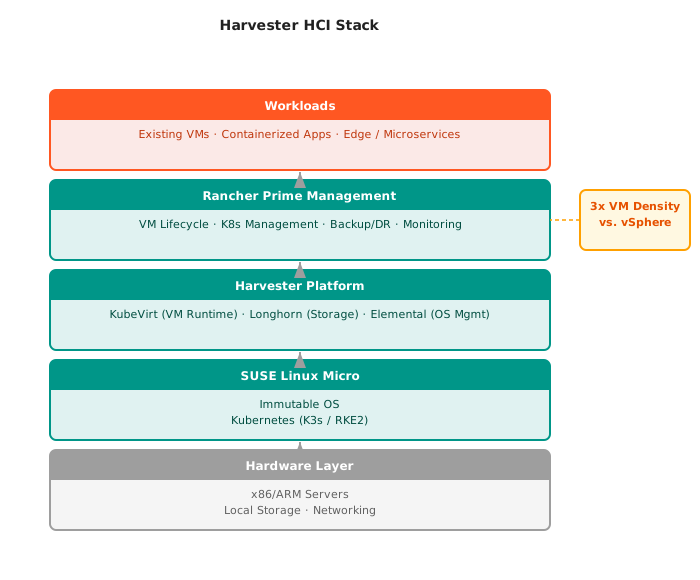
Layer Breakdown
| Layer | Component | Role |
|---|---|---|
| Host OS | Elemental / SLE Micro | Immutable, transactional-update OS; provides KVM host capability |
| Kubernetes | Upstream K8s (RKE2 / K3s variant) | Schedules VMs as pods, manages networking and storage |
| Virtualization | KubeVirt | Runs VMs inside KVM; VM CRDs (VirtualMachine, VirtualMachineInstance) |
| Storage | Longhorn | CSI-compliant distributed block storage; replication, snapshots, backups |
| Networking | Harvester CNI | VLAN-backed networks; bridge, provider networks, DHCP for VMs |
| Management | Harvester Dashboard + Rancher | Web UI, REST API, Rancher virt plugin |
Key Features
VM Lifecycle Management
VMs in Harvester are defined as Kubernetes custom resources. The full lifecycle is handled through CRDs — a typical VirtualMachine YAML manifest specifies CPU cores, memory, disks (virtio bus), network interfaces (bridge binding), and a data volume for the root disk.
Operations exposed through the UI and API:
- Create / Delete — from ISO, image templates, or clone
- Start / Stop / Restart — graceful ACPI or forced power-cycle
- Resize — live CPU/memory hotplug (KubeVirt v1.0+)
- Console access — VNC, serial console, SPICE
- Cloud-init — first-boot configuration baked into VM templates
Live Migration
Harvester supports live migration of running VMs between nodes with zero downtime:
- VM memory is copied to the target node (pre-copy phase)
- Dirty pages are iteratively transferred
- A brief pause finalizes state (downtime < 100ms typical)
- VM resumes on target node — IP, connections, and disk I/O preserved
Live Migration Requirements
- Shared storage for VM disks (Longhorn volumes are shared across nodes)
- Source and target nodes must both have capacity
- No passthrough devices (GPU, SR-IOV) may block migration
- VMs with
EvictionStrategy: LiveMigrateare automatically migrated on node drain
Backup, Snapshot & Restore
Longhorn provides the storage-layer capabilities. Harvester integrates them into the VM management workflow:
| Feature | Scope | Mechanism |
|---|---|---|
| VM Snapshots | Point-in-time disk state | Longhorn volume snapshot |
| VM Backups | Full VM + metadata to S3/NFS | Longhorn backup target |
| VM Templates | Golden images from snapshots | Convert snapshot → template |
| Restore | Back to original or new VM | From snapshot or backup |
| Scheduled Backups | Cron-based recurring backups | Backup CRD with schedule |
Storage
Storage in Harvester is Longhorn-powered (see Module 7: Longhorn & GitOps Storage for the deep dive):
- Distributed block storage — each node contributes local disks to a unified pool
- Synchronous replication — 2x or 3x replication factor for HA
- Thin provisioning — allocate on write, not on create
- Encryption — volume-level encryption with user-provided keys
- CSI driver — standard Kubernetes CSI interface for dynamic provisioning
Storage classes available to VMs:
| Storage Class | Replication | Use Case |
|---|---|---|
harvester-longhorn |
2x | General purpose |
harvester-longhorn-ha |
3x | Mission-critical VMs |
harvester-longhorn-migratable |
2x + Live Migrate flag | VMs requiring live migration |
Networking
Harvester networking uses the KubeVirt bridge binding with VLAN-backed networks:
- Management network — Kubernetes node-to-node, API traffic
- VLAN networks — one or more VLAN-tagged networks for VMs
- Provider networks — direct external network attachment
- DHCP for VMs — built-in DHCP server per network
- Network Policies — Kubernetes NetworkPolicy applies to VM traffic
Networks are defined as NAD (NetworkAttachmentDefinition) CRDs. A VM can be attached to multiple networks.
Rancher Integration
Harvester is a first-class node driver in Rancher Prime. Key integration points:
- Provision Harvester clusters from Rancher GUI (one-click deployment)
- Manage VMs inside Rancher via the
virtplugin dashboard - RBAC — Rancher project/namespace mapping controls VM access
- Multi-cluster — manage multiple Harvester clusters from a single Rancher instance
- Apps & Marketplace — deploy Helm charts alongside VMs
Rancher + Harvester = Unified Hybrid Cloud
Rancher Prime manages both container workloads (RKE2/K3s clusters) and virtual machines (Harvester) from the same dashboard. This is the foundation of the VMware off-ramp: VMs and containers co-exist under a single management plane.
SUSE Virtualization 1.5 (SUSECON 2025 Innovations)
Announced at SUSECON 2025, SUSE Virtualization 1.5 is the commercial enterprise version of Harvester with certified support and enhanced features.
Certified Storage
SUSE Virtualization 1.5 adds certified support for enterprise external storage arrays, enabling mixed-mode deployments where VMs can use either Longhorn (hyperconverged) or external SAN/NAS:
| Storage Vendor | Protocol | Use Case |
|---|---|---|
| Dell PowerStore / PowerMax | iSCSI, FC | Enterprise SAN migration |
| NetApp ONTAP | NFS, iSCSI | NAS consolidation |
| Oracle FS / ZFS | iSCSI, FC | Oracle database workloads |
| Portworx (Pure Storage) | CSI | Cloud-native storage for K8s |
CSI Support
External storage is consumed through the Kubernetes CSI interface:
- Direct CSI integration — no proprietary shim layers
- Dynamic volume provisioning — storage classes map to array pools
- Snapshot & clone — array-native snapshots via CSI
- Volume expansion — online resize through the array CSI driver
Why This Matters
This allows organizations to keep their existing SAN infrastructure while adopting Harvester — a critical requirement for VMware migration timelines where storage refresh is deferred.
VMware Off-Ramp — The Complete Migration Story
Harvester + Rancher Prime form SUSE's complete VMware off-ramp — a path to exit VMware licensing without forklifting existing virtual infrastructure.
The Migration Narrative
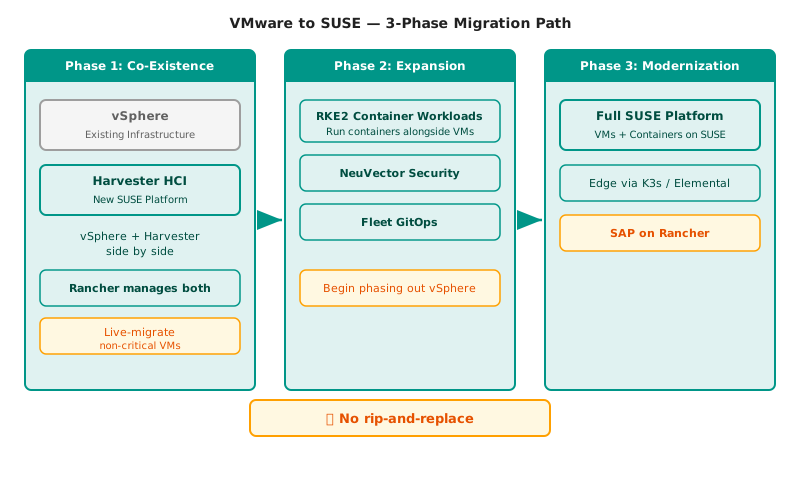
Migration Tooling
| Tool | Phase | Purpose |
|---|---|---|
| Rancher Prime | 1 | Single dashboard across vSphere + Harvester |
| VM Import Wizard | 1–2 | Convert VMware VMDK → Harvester image; retain guest OS config |
| Veeam / Commvault | 1–2 | Third-party backup migration (certified) |
| Harvester Live Migration | 2 | Rebalance VMs across nodes with zero downtime |
| Rancher Cluster API | 2–3 | Declarative cluster lifecycle for K8s nodes |
| SUSE Virtualization 1.5 CSI | 2–3 | Re-connect existing SAN to Harvester without storage migration |
Key Selling Points for VMware Migrations
- License cost elimination — no per-core VMware licensing
- Unified management — one Rancher UI for VMs + containers
- API-driven — Infrastructure-as-Code for virtual infrastructure
- Open standards — KubeVirt, Longhorn, KVM; no vendor lock-in
- Operational continuity — existing teams keep their tooling (VNC, SSH, cloud-init)
Migration Considerations
- VM templates may need OS reconfiguration (virtio drivers, cloud-init)
- GPU passthrough and SR-IOV have specific KubeVirt requirements
- DRS-equivalent load balancing uses K8s scheduling + live migration
- Existing backup tools must support KubeVirt/Longhorn targets
Maintenance Mode, Cordoning & Node Management
Harvester implements Kubernetes-native node management operations.
Node Operations
| Operation | What It Does | VM Impact |
|---|---|---|
| Cordon | Mark node unschedulable for new VMs | No impact on running VMs |
| Drain | Evict all VMs from node | VMs with LiveMigrate migrate; others shut down |
| Maintenance Mode | Cordon + drain + disable monitoring | All VMs migrated or stopped; node is offline |
| Enable Maintenance | Start maintenance mode for hardware work | VMs move to other nodes automatically |
| Disable Maintenance | Return node to service | Node re-joins cluster, VMs can be scheduled |
| Delete Node | Remove from cluster permanently | VMs must be evacuated first |
Maintenance Mode Workflow
- Enable Maintenance — Harvester cordons the node and begins draining VMs
- Live Migration — VMs with
EvictionStrategy: LiveMigratemove to healthy nodes without downtime - Forced Shutdown — VMs without migration strategy are gracefully shut down (ACPI)
- Node Offline — Node is safe to power off for hardware replacement
- Disable Maintenance — Node joins cluster, VMs can be manually restarted or re-scheduled
Production Best Practice
Always configure VM templates with EvictionStrategy: LiveMigrate for production workloads. Test maintenance mode on a non-critical node first to validate migration paths and capacity headroom on remaining nodes.
SUSE Cloud Native Positioning: "Harvester is not 'a hypervisor on Kubernetes.' It is Kubernetes becoming the hypervisor. Every VM is a pod. Every storage operation is a CSI call. Every network policy applies to virtual and container workloads equally. In a world moving toward unified infrastructure, Harvester is the only platform that starts from the cloud-native foundation and builds virtualization on top — not the other way around."
— SUSE CTO Office, Cloud Native Solutions
Cross-References
| Module | Topic | Link |
|---|---|---|
| Module 3 | Rancher Prime — managing Harvester clusters | module-03-rancher-prime.md |
| Module 7 | Longhorn deep dive — storage architecture | module-07-storage-gitops.md |
| Module 6 | Edge Computing — Harvester at the edge | module-06-edge.md |
| Module 2 | Kubernetes distributions — RKE2 underpinnings | module-02-k8s-distributions.md |
| Module 11 | MultiLinux Management | module-11-multilinux.md |