Module 4: Security — NeuVector
Module Overview
NeuVector is the only Kubernetes-native container security platform, providing full-lifecycle security from CI/CD pipeline scanning through runtime threat detection and response. It is a core pillar of the SUSE Cloud Native security posture.
What Is NeuVector?
NeuVector is an open-source-first container security platform that delivers full lifecycle security for Kubernetes workloads. It is purpose-built for containerised environments — not a traditional security tool retrofitted for K8s.
"NeuVector is the only Kubernetes-native container security platform — purpose-built from day one for containers and orchestrated by Kubernetes. It is not a ported VM security tool or a sidecar injection strategy. It understands Pods, namespaces, cluster ingress, and container networking natively."
Key differentiators:
- No sidecar injection — NeuVector enforces security at the kernel level using eBPF and netfilter
- Kubernetes-aware — It understands Pods, services, namespaces, and labels natively
- Full lifecycle — From
docker buildto production runtime, one platform covers the entire pipeline
Architecture Overview
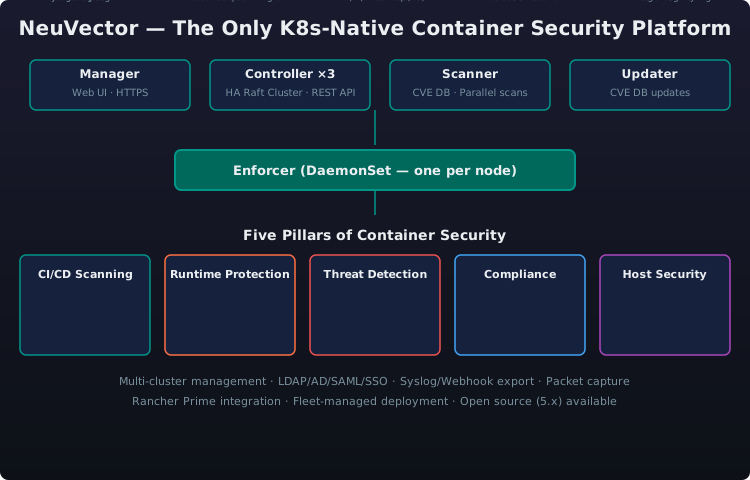
The 5 Pillars of NeuVector
1. CI/CD Vulnerability Management + Admission Control
NeuVector plugs into your CI/CD pipeline to catch vulnerabilities before they reach production:
- Image scanning — Integrates with Jenkins, GitLab CI, GitHub Actions, and others
- Registry scanning — Continuously scan container registries (Harbor, Docker Hub, ECR, ACR, GCR)
- Base OS + package scanning — Detects CVEs in Alpine, Ubuntu, Debian, RHEL, and others
- Admission control — Kubernetes ValidatingWebhook that blocks deployments failing policy (e.g., critical CVE, outdated base image, missing signature)
- SBOM generation — SPDX-compliant software bill of materials for every image
An admission control rule can be configured to block deployments with critical CVEs or missing image signatures, using a Kubernetes ValidatingWebhook.
2. Runtime Violation Protection
NeuVector monitors container behaviour at runtime and detects violations:
- Process profiling — Learns expected process trees per container; alerts on unexpected execs
- File system protection — Monitors reads/writes to critical paths; blocks unauthorised modifications
- Network micro-segmentation — Auto-generates per-container network rules based on learned behaviour
- Container drift detection — Detects when a container deviates from its original image (e.g., package install at runtime)
- Privilege escalation detection — Alerts on unexpected privilege escalation attempts
| Runtime Event | NeuVector Response |
|---|---|
kubectl exec into a Pod |
Alert + optional block |
New process spawned (e.g., curl, nc) |
Alert; auto-generate process rule |
Container writes to /etc/passwd |
Alert + file system lockdown |
| Unexpected outbound connection | Alert + auto-block (zero-trust mode) |
3. Threat Detection (DLP + WAF)
NeuVector includes application-layer threat detection:
- DLP (Data Loss Prevention) — Inspects container traffic for sensitive data patterns (credit cards, PII, API keys, tokens)
- WAF (Web Application Firewall) — Protects containerised applications from OWASP Top 10 attacks: SQLi, XSS, command injection, path traversal
- Network behaviour analytics — Detects C2 (command & control) beaconing, port scanning, DNS tunnelling
- Integrated IPS/IDS — Signature-based and anomaly-based network intrusion prevention
A DLP rule can be configured to detect exposed credentials (API keys, secrets, tokens) in container traffic, using regex pattern matching with configurable alert or block actions.
4. Compliance Auditing
NeuVector automates compliance auditing against major frameworks:
- CIS Benchmarks — Automated checks for Kubernetes (CIS K8s Benchmark), Docker, and Linux hosts
- NSA/Kubernetes Hardening Guide — Alignment with NSA's hardening recommendations
- NIST SP 800-190 — Container security standards compliance
- PCI DSS, HIPAA, GDPR — Regulatory mapping and evidence collection
- Custom compliance profiles — Define organisation-specific compliance checks
Compliance automation
NeuVector's compliance scanning runs on a schedule and generates downloadable reports suitable for auditor review. No manual checklist chasing.
5. Endpoint / Host Security
NeuVector protects the underlying host nodes as well:
- Host vulnerability scanning — Scans for CVEs on cluster nodes (OS packages, kernel)
- Host process monitoring — Detects suspicious processes running on nodes outside containers
- Host file integrity monitoring (FIM) — Monitors critical host paths (/etc, /usr/bin, /boot)
- Cluster-wide compliance — Applies CIS benchmarks to host OS configuration
- Node-level network security — Protects host network interfaces
Architecture
NeuVector uses a distributed, microservices-based architecture with five core components:
| Component | Role |
|---|---|
| Manager | Web UI (port 8443), REST API (port 10443), admin console, policy management, dashboard |
| Controller | 3 or 5 replicas with Raft consensus — orchestration leader, policy distribution, cluster state management, multi-cluster federation |
| Enforcer | DaemonSet per node — kernel-level enforcement via eBPF, packet inspection, process/file monitoring, network policy enforcement |
| Scanner | Auto-scaled deployment — image vulnerability scanning, registry scanning, CIS benchmark checks, SBOM generation |
| Updater | CronJob — periodically downloads CVE database updates and signature rules |
Component Roles
| Component | Deployment | Role |
|---|---|---|
| Manager | 1 replica (can be scaled for web UI HA) | Web console, API endpoint, policy definition, dashboard, user management |
| Controller | 3 or 5 replicas (Raft consensus) | Orchestration leader, policy distribution, cluster state management, multi-cluster federation |
| Enforcer | DaemonSet (1 per node) | Kernel-level enforcement via eBPF, packet inspection, process/file monitoring, network policy enforcement |
| Scanner | Deployment (auto-scaled) | Image vulnerability scanning, registry scanning, CIS benchmark checks, SBOM generation |
| Updater | CronJob | Periodically downloads CVE database updates and signature rules from NeuVector cloud |
Deployment Patterns
Pattern 1: High Availability (Recommended for Production)
Best for production environments with strict uptime requirements:
For production environments with strict uptime requirements, this pattern deploys 3 Controller pods (Raft consensus, tolerates 1 failure), 1 Manager pod, a Scanner pod (auto-scaled to 3 during scans), an Enforcer DaemonSet on every node, an Updater CronJob, and a LoadBalancer or Ingress for the Manager UI. It tolerates a single controller failure with ~5 second failover and is recommended for production clusters with more than 5 nodes.
- Tolerates a single controller failure
- Failover time ~5 seconds
- Recommended for production clusters with >5 nodes
Pattern 2: All-in-One (Single Replica)
Best for development, testing, and smaller clusters:
For development, testing, and smaller clusters, this pattern deploys a single Controller replica (no HA), a co-located Manager, one Scanner, an Enforcer DaemonSet on every node, and an Updater CronJob. It has no HA (controller restart causes brief policy interruption) with a footprint of approximately 1 vCPU / 2 GB RAM plus enforcer per node. Recommended for dev/test clusters and clusters with fewer than 5 nodes.
- No HA — controller restart causes brief policy interruption
- Footprint ~1 vCPU / 2 GB RAM (plus enforcer per node)
- Recommended for dev/test clusters and clusters with <5 nodes
Pattern 3: Per-Node DaemonSet (Enforcer-Only Mode)
For air-gapped or resource-constrained environments:
For air-gapped or resource-constrained environments, a central Controller/Manager runs on a management cluster while an Enforcer-only DaemonSet is deployed on each workload cluster. Enforcers report back to the central Controller, and Scanners run on the management cluster only. This provides minimal footprint on workload nodes (~0.3 vCPU / 512 MB RAM per enforcer), centralised management via a single console for all clusters, and is ideal for edge clusters, air-gapped deployments, and ARM nodes.
- Minimal footprint on workload nodes (~0.3 vCPU / 512 MB RAM per enforcer)
- Centralised management — one console for all clusters
- Recommended for edge clusters, air-gapped deployments, ARM nodes
NeuVector vs Falco vs Aqua
| Dimension | NeuVector | Falco | Aqua Security |
|---|---|---|---|
| K8s-native |  Built for K8s from day one Built for K8s from day one |
 Runtime-focused, needs integrations Runtime-focused, needs integrations |
Originated as VM-era tool, adapted for K8s |
| CI/CD scanning | Full CI/CD pipeline integration |
 Not included Not included |
Full pipeline scanning |
| Runtime security | eBPF + netfilter dual-engine |
eBPF-based syscall monitoring |
eBPF + sidecar approaches |
| WAF / DLP | Built-in L7 inspection |
Not included |
Add-on module |
| Network micro-segmentation | Auto-learn + enforce |
Alerts only (no enforce) |
Full enforcement |
| Admission control | Built-in ValidatingWebhook |
Falco Admission Controller (separate) |
Built-in |
| Compliance auditing | CIS, NIST, PCI, HIPAA, GDPR |
Limited to Falco rules |
Full compliance suite |
| Host security | Host scanning + FIM |
Container-focused only |
Host + container |
| Open-source | Apache 2.0 (core) |
Apache 2.0 |
Proprietary (core) |
| Integration with Rancher | Native (one-click deploy) |
Manual integration |
Manual integration |
| Pricing | Free (community) + Prime subscription | Free (open-source) | Per-node license (expensive) |
| Dimension | Winner |
|---|---|
| Best K8s-native security | NeuVector |
| Best free runtime monitoring | Falco |
| Best enterprise suite (non-SUSE) | Aqua |
| Best Rancher integration | NeuVector |
| Best open-source community | Falco |
Integration with Rancher Prime
NeuVector integrates seamlessly with Rancher Prime:
One-Click Deployment
- NeuVector appears in the Rancher Prime Apps & Marketplace catalog
- Deploy to any managed or imported cluster with a single click
- Pre-configured security profiles aligned with Rancher's hardening guides
Unified Dashboard
- Security events (critical CVEs, runtime violations) appear in the Rancher Prime dashboard
- NeuVector vulnerability reports per-namespace and per-project
- Alert notifications routed through Rancher's alerting system
Policy Federation
- Define NeuVector security policies at the Rancher level
- Propagate policies to all clusters via Fleet GitOps
- Enforce consistent security posture across development, staging, and production
Cross-Cluster Visibility
- One NeuVector console managing security across all Rancher-managed clusters
- Centralised compliance reporting for multi-cluster environments
- Federated CVE scanning across registries used by all clusters
A Fleet GitOps bundle can deploy NeuVector across all production clusters with a single configuration, specifying controller replicas, enforcer, scanner, and admission control settings via Helm values.
The "Why NeuVector" Positioning Script
"Your customer asks: 'We already run Falco for runtime security and Trivy for scanning — why do we need NeuVector?'
Here's why: You're stitching together four different tools for four different jobs — Falco for runtime, Trivy for scanning, a separate admission controller, and a separate WAF. None of them talk to each other. None of them are Kubernetes-native. And none of them are backed by an enterprise SLA.
NeuVector replaces all four with one platform. One agent, one policy model, one dashboard, one support line. It's the only container security platform that covers the full lifecycle — CI/CD scanning, admission control, runtime protection, DLP/WAF, compliance auditing, and host security — in a single, Kubernetes-native deployment.
And because it integrates natively with Rancher Prime, you get security policies that travel with your workloads across dev, staging, and production — without reconfiguration."
Summary
| Topic | Key Takeaway |
|---|---|
| What it is | Only K8s-native full-lifecycle container security platform |
| 5 pillars | CI/CD vuln mgmt, runtime protection, threat detection (DLP+WAF), compliance auditing, host security |
| Architecture | Manager + Controller (Raft) + Enforcer (eBPF DaemonSet) + Scanner + Updater |
| Deployment | HA (3 controllers), All-in-One (single), Enforcer-only (edge/air-gapped) |
| vs Falco | NeuVector is broader (WAF, DLP, compliance, admission); Falco is narrower (runtime only) but fully open-source |
| vs Aqua | NeuVector is more K8s-native, open-source core, and cheaper; Aqua is more mature as a pure-play enterprise suite |
| Rancher integration | One-click deploy, unified dashboard, policy federation via Fleet |
| Open-source | Core is Apache 2.0; enterprise features in Prime subscription |
Further Reading
- Module 3: Rancher Prime Multi-Cluster Management — The platform NeuVector integrates with
- Module 9: Ecosystem & Competitive Landscape — How NeuVector compares to the broader security market
- Module 11: MultiLinux Management — Managing heterogeneous Linux distributions across the Kubernetes fleet